
Composting & Disposing of Your Loofah: How to Close the Loop Sustainably
Share
Why Disposal Matters Just as Much as Your Skincare Choices
You shop sustainably, buy plastic-free, and choose natural materials — like a loofah sponge instead of a synthetic exfoliating glove. But what happens when the sponge has run its course? Does it end up in the bin anyway, heading for landfill? It doesn't have to. A genuine loofah from the luffa plant is 100% biodegradable — which means it can simply be composted.
This article explains when it's time to replace your loofah, how to prepare it properly for disposal, and what to keep in mind when composting. Because sustainable exfoliation doesn't stop at the last step.
When Is It Time to Replace Your Loofah?
Before we get to disposal, the most important question: when is the right time to switch?
Rule of thumb: every 4 to 8 weeks, depending on how often you use it and how well you care for it. Concrete signs that your loofah sponge has done its job:
- Unpleasant smell that lingers after rinsing — a sign of bacterial build-up in the fibres
- Fibre structure breaks down or crumbles when touched
- Discolouration that won't wash out (mould spots)
- Loss of exfoliating effect — the sponge feels too soft and merely glides over the skin
A well-maintained loofah that is thoroughly dried after each use often lasts 6 to 8 weeks. One that sits damp in the shower tends to last significantly less. Better to switch sooner — and then dispose of it with a clear conscience.
Is a Loofah Really Compostable?
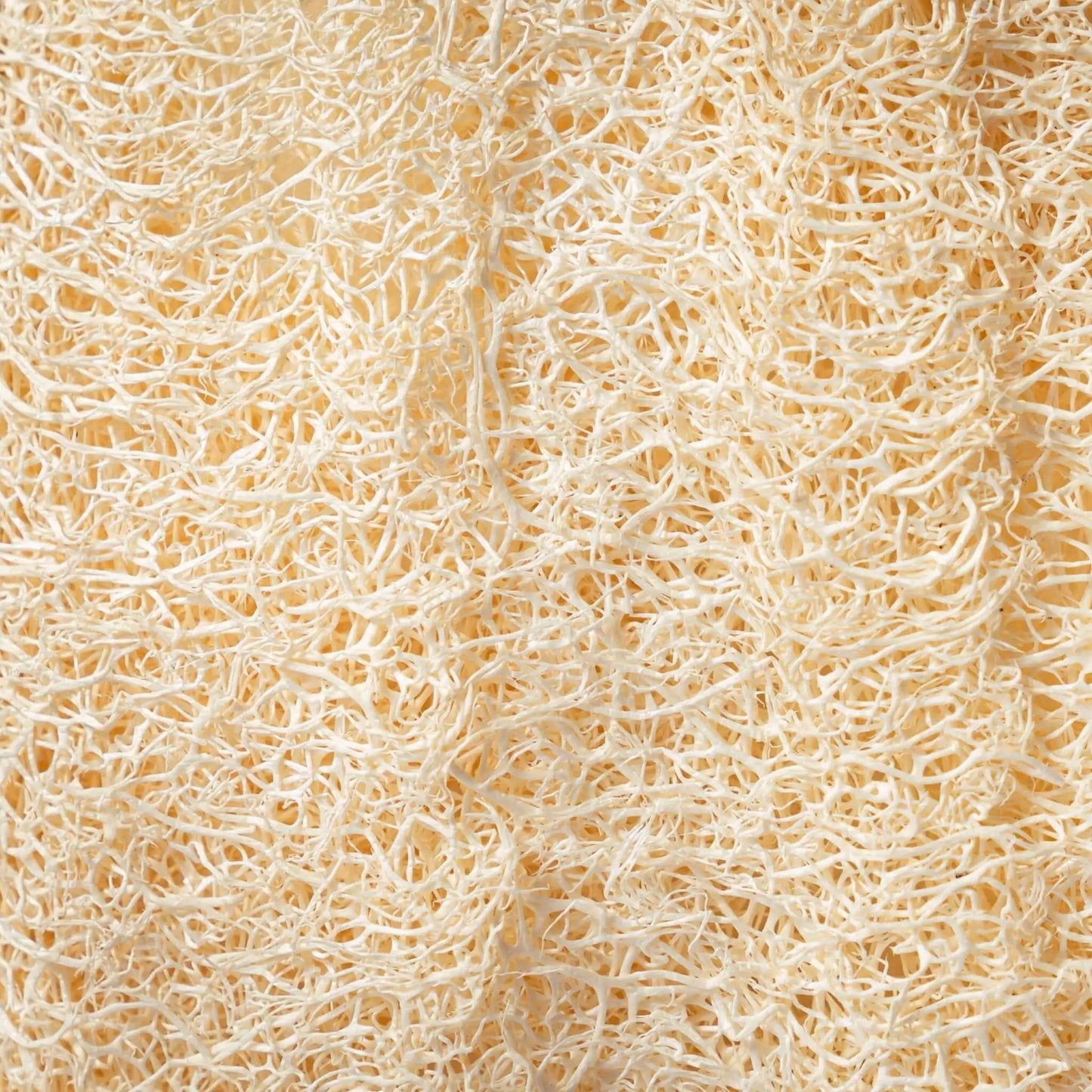
Yes — completely. A loofah sponge is the dried inner skeleton of the fruit of the luffa plant (Luffa cylindrica or Luffa aegyptiaca), a member of the gourd family. The material consists entirely of plant cellulose fibres — no plastic, no synthetic resin, no artificial binders.
That means: under the right conditions, the loofah sponge is fully broken down by microorganisms, just like kitchen scraps, leaves, or cardboard.
Decomposition time in compost: between 2 and 6 months, depending on moisture, temperature, and composting method. A well-maintained hot compost bin works faster; a slow cold composter takes longer.
For comparison: A synthetic exfoliating glove takes 50 to 500 years to break down depending on the material — and releases microplastics in the process. The loofah simply becomes compost.
Preparation: Getting Your Loofah Ready for the Compost
For the best breakdown, a few quick steps:
- Rinse out soap residue: Rinse the old loofah thoroughly under warm water. Larger amounts of soap can slow down composting by affecting the pH level in the compost.
- Let it dry briefly: A drier sponge is easier to cut and distributes more evenly in the compost. It doesn't need to be completely dry, though.
- Cut into small pieces: Use kitchen scissors or an old knife to cut the loofah into several pieces — roughly 4 to 6 sections. Smaller pieces break down significantly faster.
- Shake out any seeds (if present): If you're using a sponge from your own plants that still contains seeds, you can shake them out. Store-bought loofah sponges are usually seed-free.
- Remove any attachments before disposing: If your loofah is attached to a rope, cord, or hook — remove these first. Natural fibre cords (cotton, jute) can be composted; plastic cords go in the general waste bin.
Composting: Home Compost, Food Waste Bin, or Worm Farm?
You have several options:
Home compost in the garden The best option. Simply work the prepared pieces in — lightly bury them in the compost mass so microorganisms can reach them well. Maintain moisture regulation as usual.
Food waste / green bin Also an option, depending on your local council. Most councils accept compostable materials in their organic waste collection. If in doubt, check with your local authority — as a rule: 100% plant-based = green bin accepted.
Worm farm Worm composting works too, but use smaller pieces and don't add too many at once, as the cellulose fibres take a little more work for the worms to process. The resulting castings are especially valuable, though.
What if you don't have a compost? Without your own compost and without a food waste collection: general waste bin. A loofah in the bin will end up in landfill or incineration — but you already made the more sustainable choice at the point of purchase. No reason to feel guilty.
Other Uses Before Disposal
Before a sponge needs to go, there's sometimes one last job left for it:
- Use as a dish sponge: A loofah that's too worn for bodycare can still do a brief stint as a kitchen scrubber — then compost it.
- As a planting aid: Place small loofah pieces in planting holes — they retain moisture and break down in the soil.
- As a seed germination mat: Loofah pieces work well as a natural germination medium for seeds (moisten, place seeds inside).
Loofah vs. Plastic Alternatives: The Sustainability Comparison at a Glance
| Feature | Loofah Sponge | Synthetic Exfoliating Glove | |---|---|---| | Material | 100% plant fibre | Nylon, polyester, etc. | | Compostable | Yes | No | | Decomposition time | 2–6 months | 50–500 years | | Microplastics when used | No | Yes (microfibres) | | Renewable resource | Yes | No | | Exfoliating effect | High | Medium–High |
The conclusion is clear: once you've switched to loofah, you leave plastic gloves behind for good — and at the end of the product's life, disposal is completely guilt-free.
FAQ: Common Questions About Loofah Disposal
Can I just put my loofah on the ground in the garden without a compost bin? Yes, it works — but it takes longer. Better to bury the pieces in the top layer of soil, so microorganisms and moisture can reach them easily. Leaving them on the surface dries them out and slows decomposition significantly.
Can I compost a loofah sponge that has mould spots? Yes, absolutely. Mould is a natural decomposition process — the mould fungi actually help break down the cellulose fibres in the compost.
What do I do if my loofah came packaged in a plastic net? The net goes in the general waste or recycling bin (depending on material labelling). The loofah itself goes to compost. Loofah Crafts packages its sponges plastic-free — the packaging can also be composted or recycled.
How many loofah sponges can I put in the compost at once? In a standard household compost, 2 to 3 sponges can easily be worked in at once. In a worm farm, add one at a time.
How can I tell if my loofah is made from a real luffa plant? A genuine loofah feels woody and fibrous, has a mild plant scent (not synthetic), and is a uniform light beige to light brown. If your "loofah" is colourful, very soft, and uniform — it could be synthetic. Loofah Crafts uses only genuine luffa plant sponges.
Conclusion: With Loofah, Even the End Is Sustainable
Shower plastic-free, exfoliate plastic-free — and now dispose plastic-free too. A loofah sponge, chopped into pieces and added to the compost, becomes earth again within a few months. No microplastics, no landfill, no guilty conscience.
That's the full circle: from the field to your shower, from sponge back to earth. Sustainability that's truly thought through from beginning to end — exactly what Loofah Crafts stands for.
Discover our natural loofah sponges and start an exfoliating routine you can enjoy completely guilt-free.